
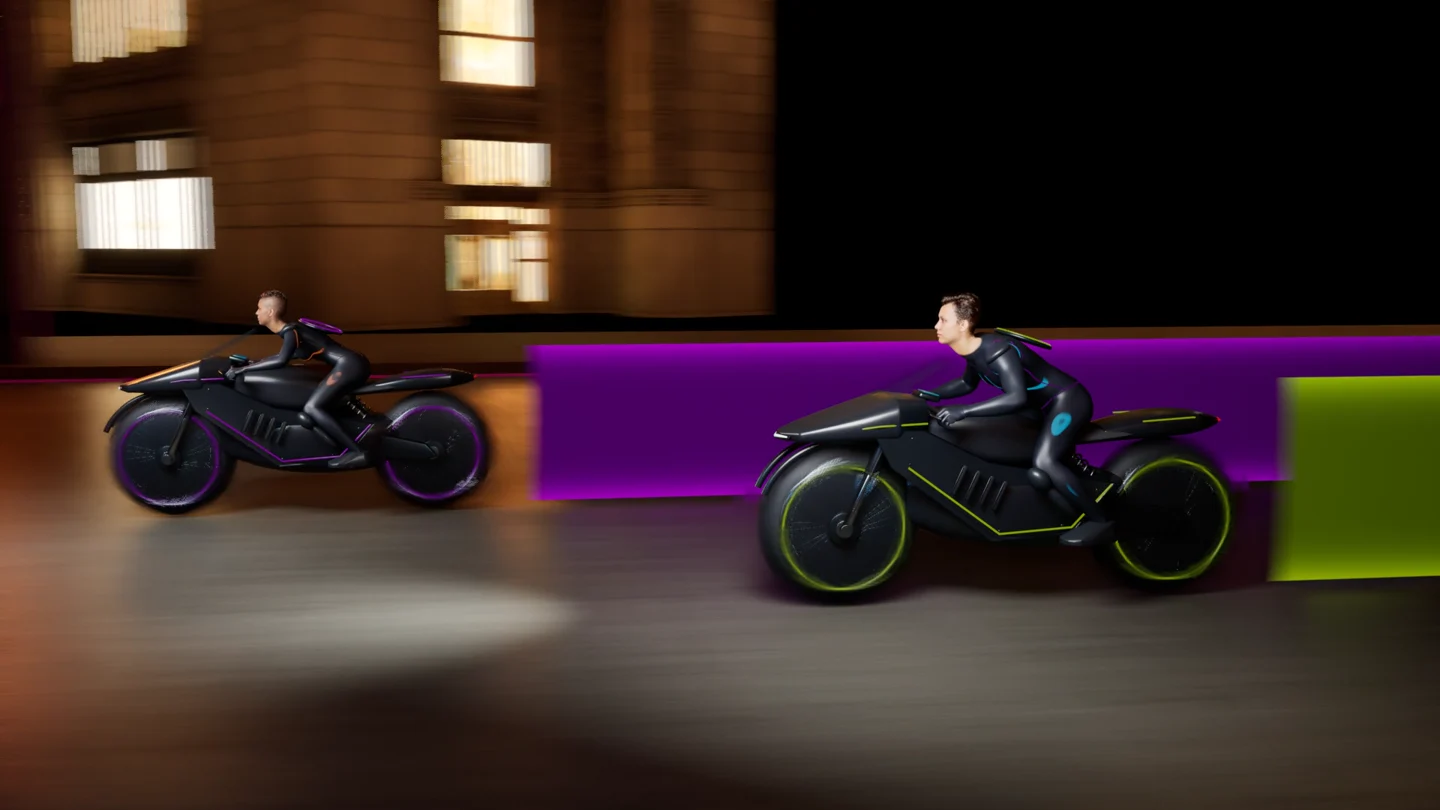
Speed needs a reference point
A bike can cross an enormous space without looking fast if the only reference is a distant skyline. The chase works when near and far objects move at different rates. In the Causeway footage, lane edges and light trails pass close to the lens while the towers turn slowly above them. The difference makes it possible to feel velocity before a speedometer appears.
When blocking a new route, try a deliberately flat lighting pass first. If the street reads as fast with a simple shader and a few foreground markers, reflections and effects will have something to build on. When it does not, another layer of emissive materials rarely fixes the camera.
Give the camera a job
A low tracking shot makes the road feel dangerous. A wider shot teaches the audience the geometry of the next corner. A rider close-up shows who is making the choice. A cut earns its place when it tells the viewer something that the preceding shot could not.
Keep a playable camera and a cinematic camera in separate review lanes. A sweeping slide can make a four-second shot. In play, a sudden swing through the horizon can hide an obstacle and turn a precise input into a guessing game.
Keep the visual hierarchy at racing speed
A color treatment has to survive peripheral vision. Use a strong light or color near the next decision, with quieter detail around it. Let highlights follow the road material rather than turning every surface into a mirror. A rider silhouette should still read if the most luminous element is removed from the frame.
Review motion with sound off and the picture reduced to a phone-size preview. If the turn, the rival position, or the point of impact becomes unreadable, identify that beat and fix its composition before adding detail.
The next capture
Capture the same street from the same start point and review the same decisions after each lighting, effects, or vehicle pass. A comparison is only fair when camera, resolution, frame pacing, and input are documented. The footage here is an early Unreal development capture. Follow the project page for how current builds evolve.